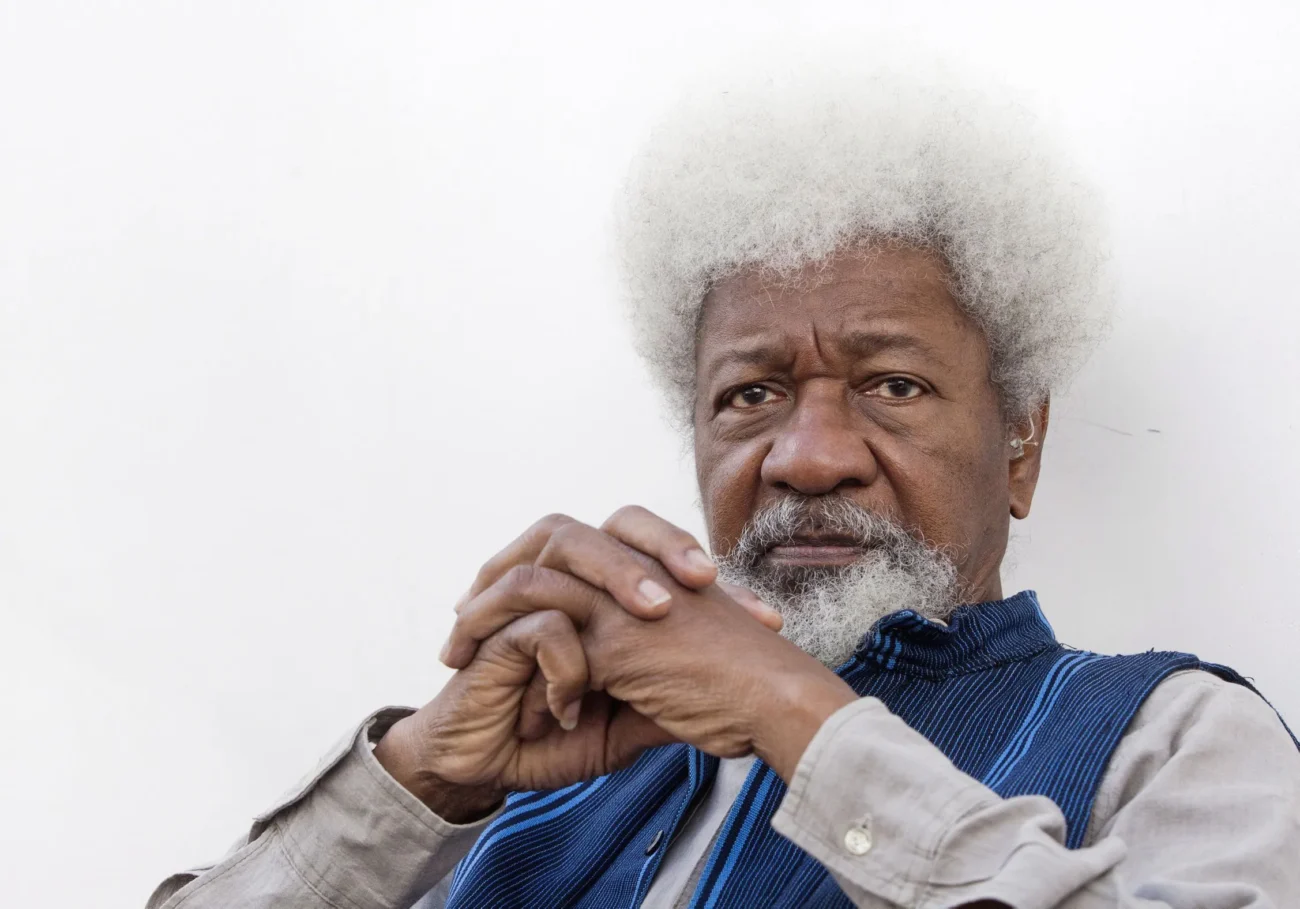
Wole Soyinka is a Nigerian playwright, poet, novelist, essayist, and political activist who, in 1986, became the first Black African to receive the Nobel Prize in Literature.
Over a career spanning more than six decades, he has used drama, poetry, and public activism to challenge authoritarian power across Africa, blending Yoruba mythology with Western literary form to create a body of work regarded as among the most significant in modern African literature.
Profile
| Full Name | Akinwande Oluwole Babatunde Soyinka |
| Stage Name | Wole Soyinka |
| Date of Birth | July 13, 1934 |
| Age | 92 |
| Birthplace | Aké, Abeokuta, Ogun State, Nigeria |
| Nationality | Nigerian |
| Occupation | Playwright, Poet, Novelist, Essayist, Professor, Political Activist |
| Parents | Samuel Ayodele Soyinka (Anglican minister and headmaster) and Grace Eniola Soyinka, known as “Wild Christian” (shopkeeper and community activist) |
| Siblings | Second of seven children |
| Spouse | Married three times: Barbara Dixon (m. 1958), Olaide Idowu (m. 1963), and Folake Doherty (m. 1989–present) |
| Children | Several, including Olaokun Soyinka, Morenike Soyinka, Makin Soyinka, Moremi Soyinka-Onijala, and Peyibomi Soyinka-Airewele |
| Net Worth | $1.5 million to $20 million |
Early Life
Wole Soyinka was born Akinwande Oluwole Babatunde Soyinka on July 13, 1934, in the Aké quarter of Abeokuta, in present-day Ogun State, Nigeria, into an Anglican Yoruba family. He was the second of seven children.
His father, Samuel Ayodele Soyinka, was an Anglican minister and headmaster of St. Peter’s School in Abeokuta, with ancestral ties to the royal family of Isara-Remo, while his mother, Grace Eniola Soyinka, known locally as “Wild Christian,” ran a shop and was active in community affairs.
Growing up in a mission compound, Soyinka absorbed both his parents’ Christian teachings and the Yoruba spiritualism and customs of his grandfather, and as a notably inquisitive child he reportedly prompted the adults around him to warn one another, “He will kill you with his questions.”
Education
Soyinka attended St. Peter’s Primary School in Abeokuta, where his father was headmaster, followed by Abeokuta Grammar School and Government College, Ibadan.
He then studied English literature, Greek, and Western history at University College, Ibadan, from 1952 to 1954, before continuing his education in England at the University of Leeds, where he served as editor of the student magazine The Eagle and graduated with a degree in English literature in 1958. He later returned to Leeds to complete a doctorate in 1973.
Career
Soyinka worked as a dramaturgist at London’s Royal Court Theatre from 1958 to 1959 before returning to Nigeria on a Rockefeller bursary to study African drama.
He founded the theater group “The 1960 Masks” in 1960 and the Orisun Theatre Company in 1964, staging his own plays and performing as an actor. His early works, including The Swamp Dwellers and The Lion and the Jewel, were first performed in Ibadan in the late 1950s.
During the Nigerian Civil War, Soyinka publicly appealed for a ceasefire and was arrested in 1967 on accusations of conspiring with Biafran separatists, spending 22 months as a political prisoner until 1969, an experience he documented in his prison memoir, The Man Died.
In 1986, Soyinka became the first African recipient of the Nobel Prize in Literature, honored for work that the Nobel Committee described as fashioning “the drama of existence” through a wide cultural lens and poetic intensity.
He dedicated his Nobel lecture, “This Past Must Address Its Present,” to Nelson Mandela and used the address to condemn apartheid. Soyinka taught comparative literature at Obafemi Awolowo University in Ife from 1975 to 1999, later becoming Professor Emeritus, and held visiting professorships at Cornell, Emory, Loyola Marymount, the University of Nevada Las Vegas, New York University, Cambridge, Oxford, Harvard, Yale, and Duke, among others.
In 2010, he founded the Democratic Front for a People’s Federation, serving as its chairman, and has remained a vocal critic of authoritarianism and corruption in Nigerian politics into his nineties.
Awards
- 1967 — John Whiting Award — For The Interpreters — Won
- 1983 — Anisfield-Wolf Book Award — For Aké: The Years of Childhood — Won
- 1986 — Nobel Prize in Literature — — Won
- 1986 — Agip Prize for Literature — — Won
- 1990 — Benson Medal, Royal Society of Literature — — Won
- 1990 — Mondello Prize — Special Jury Prize — Won
- 2013 — Anisfield-Wolf Book Award — Lifetime Achievement — Won
- 2017 — Europe Theatre Prize — Special Prize — Won
Personal Life
Soyinka has been married three times: to British author Barbara Dixon in 1958, with whom he had two children; to Nigerian librarian Olaide Idowu in 1963, with whom he had four more children; and to Folake Doherty since 1989.
He has said he is drawn more to myth and cultural symbolism than to organized religion, despite his Anglican upbringing. Soyinka holds the traditional Yoruba honorific “Oloye” and has been given the chieftaincy titles of “Akogun” of Isara-Remo and “Akinlatun” of Egbaland.
He has periodically lived in exile from Nigeria during periods of political repression, most notably during the 1990s under military rule. In recognition of his legacy, the University of Ibadan renamed its arts theater the Wole Soyinka Theatre in 2018, and in October 2025, Nigeria’s National Theatre was renamed the Wole Soyinka Center for Culture and Creative Arts.
Net Worth
Estimates of Wole Soyinka’s net worth vary considerably across sources, ranging from approximately $1.5 million to $20 million, with no single confirmed figure.
His income has come primarily from book sales, university teaching and visiting professorships, speaking engagements, and literary prizes rather than from commercial business ventures.
Selected Works
- A Dance of the Forests (1960, play)
- The Lion and the Jewel (1959, play)
- The Trials of Brother Jero (1960, play)
- The Interpreters (1965, novel)
- Kongi’s Harvest (1965, play)
- Idanre and Other Poems (1967, poetry)
- The Man Died: Prison Notes (1972, memoir)
- Season of Anomy (1973, novel)
- Death and the King’s Horseman (1975, play)
- Myth, Literature and the African World (1975, essays)
- Aké: The Years of Childhood (1981, memoir)
- A Play of Giants (1984, play)
- You Must Set Forth at Dawn (2006, memoir)
Conclusion
From his imprisonment during the Nigerian Civil War to his landmark Nobel Prize win and his continued activism into his nineties, Wole Soyinka’s life reflects an enduring belief that literature carries moral and political responsibility.
His fusion of Yoruba tradition with Western dramatic form reshaped African literature’s place on the world stage and continues to influence generations of writers and activists.
