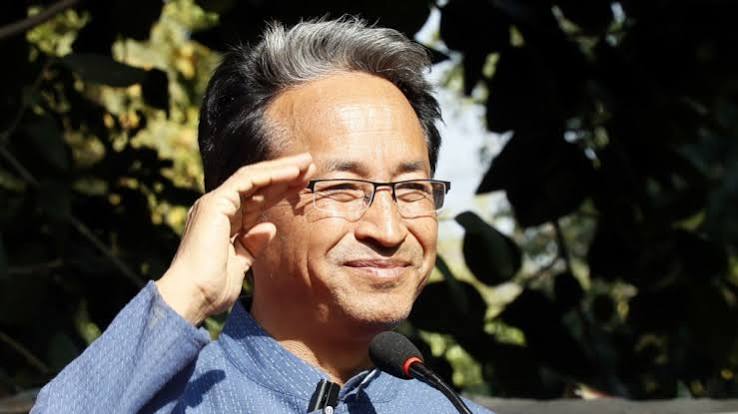
Sonam Wangchuk is one of India’s most celebrated engineers and social innovators, known for transforming education and sustainable living in Ladakh and for later becoming a prominent, and controversial, voice in the movement for Ladakh’s constitutional protections.
Often described as the real-life inspiration behind a beloved Bollywood character, his story spans innovation, education reform, and activism. Here’s a complete look at his life and work.
Who Is Sonam Wangchuk?
Sonam Wangchuk is an Indian engineer, education reformer, innovator, and environmental activist from Ladakh, best known as the founding director of the Students’ Educational and Cultural Movement of Ladakh (SECMOL) and as the inventor of the “Ice Stupa” technique for creating artificial glaciers to address water scarcity in the Himalayas.
He is widely recognized as the real-life inspiration behind the character Phunsukh Wangdu, played by Aamir Khan in the 2009 Bollywood film “3 Idiots,” though he has disavowed a direct comparison.
Profile
| Full Name | Sonam Wangchuk |
| Born | September 1, 1966 |
| Age | 59 years old |
| Birthplace | Village near Alchi, Leh district, Ladakh, India |
| Nationality | Indian |
| Occupation | Engineer, Education Reformer, Innovator, Environmental Activist |
| Education | B.Tech, Mechanical Engineering, National Institute of Technology, Srinagar (1987); Earthen Architecture, CRAterre School of Architecture, Grenoble, France (2011) |
| Parents | Sonam Wangyala (father, Congress politician); mother (first teacher, taught him until age 9) |
| Spouse | Gitanjali J. Angmo |
| Known For | Founder of SECMOL; inventor of the Ice Stupa; Ladakh statehood activism |
Early Life
Sonam Wangchuk was born on September 1, 1966, in a village near Alchi in Ladakh’s Leh district. His early years were shaped by isolation from formal education, as there were no schools in his village; his mother served as his first teacher, instructing him in his native language until the age of nine. He enrolled in a school in Srinagar at age nine, after his father, Sonam Wangyala, a Congress politician, was posted there. However, Wangchuk struggled due to language differences and moved to Delhi alone in 1977, where he successfully pleaded his own case to gain admission at Vishesh Kendriya Vidyalaya.
After completing his schooling, Wangchuk faced a pivotal decision: he wanted to pursue mechanical engineering, while his father wanted him to study civil engineering and return to Ladakh to build infrastructure. When his father threatened to withdraw financial support if he did not comply, Wangchuk chose to finance his own education instead. At 19, he opened a summer tuition center in Ladakh that attracted around 100 students, raising enough money in two months to fund three years of engineering college.
Education
Wangchuk pursued a Bachelor of Technology in Mechanical Engineering at the National Institute of Technology (NIT) in Srinagar, graduating in 1987, going against his father’s wishes in choosing his field of study. In 2011, he furthered his education in sustainable design by studying Earthen Architecture at the CRAterre School of Architecture in Grenoble, France, knowledge that later informed his sustainable building projects in Ladakh.
Career
In 1988, shortly after graduating, Wangchuk co-founded the Students’ Educational and Cultural Movement of Ladakh (SECMOL) alongside his brother and several peers, founded by students who considered themselves, in Wangchuk’s words, “victims” of an education system ill-suited to Ladakh. In 1994, he spearheaded Operation New Hope, a collaborative reform initiative between the government, village communities, and civil society aimed at improving Ladakh’s government school system.
Wangchuk designed the SECMOL campus to run entirely on solar energy, using no fossil fuels for cooking, heating, or lighting, even amid Ladakh’s harsh sub-zero winters, using passive solar heating and rammed-earth construction techniques. In July 2016, SECMOL’s “Big Building” won the International Terra Award at the 12th World Congress on Earthen Architecture in Lyon, France. He also developed mobile solar-powered tents for the Indian Army and worked as an editor of Ladags Melong, Ladakh’s only print magazine.
Wangchuk gained international recognition for inventing the “Ice Stupa” technique, a method of creating cone-shaped artificial glaciers that store winter water for release during dry spring months, addressing critical water scarcity issues facing Himalayan farming communities. He later founded the Himalayan Institute of Alternatives, Ladakh (HIAL), aimed at promoting context-based, sustainable education.
Wangchuk’s public profile shifted significantly in the following years as he became a leading voice in the movement for Ladakh’s constitutional protections, calling for the region’s inclusion in the Sixth Schedule of the Indian Constitution and for statehood, aiming to secure local land rights and protect Ladakh’s cultural and ecological identity against industrial and mining interests. He undertook multiple hunger strikes in support of these demands, including a 21-day climate fast in 2024. In September 2024, he led a “Delhi Chalo Padyatra” march from Ladakh to Delhi, during which he was briefly detained at the Delhi-Haryana border before being released on Gandhi Jayanti.
In September 2025, following protests in Leh that turned deadly, with clashes between demonstrators and police resulting in several deaths, Wangchuk was arrested and detained under India’s National Security Act (NSA), a law permitting preventive detention without trial. Authorities alleged that his public statements, including references to international protest movements, had contributed to inciting the unrest; Wangchuk and his supporters maintained that his activism was peaceful. His wife, Gitanjali J. Angmo, filed a habeas corpus petition challenging his detention before the Supreme Court of India. Following legal proceedings and public advocacy from civil society groups, academics, and environmentalists, the Ministry of Home Affairs revoked his NSA detention, and Wangchuk was released on March 14, 2026, after approximately 170 days in custody.
Awards
- Ramon Magsaysay Award (2018), one of Asia’s highest humanitarian honors
- Rolex Awards for Enterprise (2016), for his work assisting farmers in Ladakh through the Ice Stupa project
- Honorary Doctor of Letters (D.Litt) degree for his contributions to innovation and education
- International Terra Award, 12th World Congress on Earthen Architecture, Lyon, France (2016), for SECMOL’s “Big Building”
Social Media
Sonam Wangchuk maintains a public profile through media appearances and public advocacy, particularly in relation to Ladakh’s environmental and constitutional rights movement, though his primary visibility comes through news coverage rather than personal social media promotion.
Personal Life
Sonam Wangchuk is married to Gitanjali J. Angmo, who has played an active role in advocating for his release during his 2025–2026 detention, including filing a habeas corpus petition before the Supreme Court of India. Wangchuk has spoken about how his father’s political background and his own early independence, including moving to Delhi alone as a child to secure his education, shaped his resilience and commitment to social reform. He has consistently disavowed direct personal comparisons to the “3 Idiots” character inspired by his life, preferring instead to be recognized for his substantive work in education and sustainability.
Net Worth
Specific net worth figures for Sonam Wangchuk are not publicly disclosed or widely reported, as his life’s work has centered on nonprofit educational and environmental initiatives rather than personal commercial ventures.
FAQs
Is Sonam Wangchuk the real Phunsukh Wangdu?
His life story inspired Aamir Khan’s character in “3 Idiots,” though Wangchuk has disavowed a direct comparison.
What is the Ice Stupa?
It is an artificial glacier technique invented by Wangchuk to store winter water in a cone-shaped ice heap for use during dry seasons in Ladakh.
Why was Sonam Wangchuk detained in 2025?
He was detained under India’s National Security Act following deadly protests in Leh, with authorities alleging his statements contributed to the unrest; he was released in March 2026 after the detention was revoked.
What organization did Sonam Wangchuk found?
He co-founded the Students’ Educational and Cultural Movement of Ladakh (SECMOL) in 1988.
What awards has Sonam Wangchuk received?
He has received the Ramon Magsaysay Award and the Rolex Awards for Enterprise, among other honors.
Conclusion
From a childhood without formal schooling in a remote Ladakhi village to becoming one of India’s most respected engineers and social reformers, Sonam Wangchuk’s life reflects a rare combination of technical innovation and social conviction.
His recent role at the center of Ladakh’s constitutional rights movement, including his prolonged detention and eventual release, underscores how his work has evolved from education and sustainability into one of India’s most closely watched contemporary political and civil rights issues.
