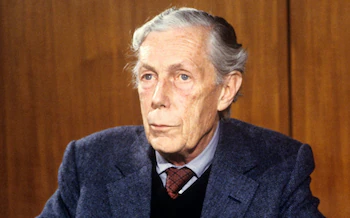
Sir Anthony Blunt was one of twentieth-century Britain’s most distinguished art historians, serving as Surveyor of the King’s and later Queen’s Pictures and director of the Courtauld Institute of Art.
He is equally remembered as one of the “Cambridge Five,” a group of British academics recruited as spies for the Soviet Union in the 1930s, whose decades-long secret espionage career was only publicly exposed near the end of his life.
Profile
| Full Name | Anthony Frederick Blunt |
| Date of Birth | September 26, 1907 |
| Date of Death | March 26, 1983 (aged 75) |
| Birthplace | Bournemouth, Hampshire, England |
| Nationality | British |
| Occupation | Art historian, professor, writer, intelligence officer, Soviet spy |
| Parents | Arthur Stanley Vaughan Blunt (Anglican clergyman); Hilda Master Blunt |
| Siblings | Wilfrid Blunt (art historian); Christopher Evelyn Blunt (numismatist) |
Early Life
Anthony Frederick Blunt was born on September 26, 1907, in Bournemouth, Hampshire, England, to Arthur Stanley Vaughan Blunt, a clergyman who served as chaplain to the British Embassy in Paris, and Hilda Master Blunt.
Through his father’s family he was a distant cousin of the Queen Mother. He developed an early appreciation for French art and architecture during time spent in France as a child.
Education
Blunt was educated at Marlborough College before going up to Trinity College, Cambridge, graduating in 1930. He remained at Cambridge to teach French and was elected a fellow of Trinity College in 1932 on the strength of his research into sixteenth- and seventeenth-century artistic theory.
Career
Blunt began his professional life as an art critic for The Spectator before pursuing an academic career in art history. During the 1930s at Cambridge he became involved with a circle of Marxist intellectuals associated with Guy Burgess, and in 1934 he was recruited by Soviet intelligence, going on to recruit Kim Philby, Donald Maclean and John Cairncross into what later became known as the Cambridge Five spy ring. He served in British Army intelligence during the Second World War and was recruited into MI5 in 1940, rising to the rank of major while covertly passing information to the Soviet Union. In 1945 he was appointed Surveyor of the King’s (later Queen’s) Pictures, a post he held for 27 years, and in 1947 he became director of the Courtauld Institute of Art, a position he held until his retirement in 1974. His 1967 monograph on the French Baroque painter Nicolas Poussin is still regarded as a landmark work of art history. In 1963 an American former associate, Michael Straight, informed the FBI of Blunt’s espionage activities; British intelligence subsequently secured a confidential confession from Blunt in 1964 in exchange for immunity from prosecution. His espionage was not made public until November 1979, when Prime Minister Margaret Thatcher revealed it to Parliament, after which Blunt was stripped of the knighthood (KCVO) he had held since 1956 and expelled from the fellowship of the British Academy.
Awards & Nominations
- 1956 — Knight Commander of the Royal Victorian Order (KCVO) — Awarded, revoked in 1979
Personal Life
Blunt’s homosexuality, illegal in Britain for much of his life, was disclosed publicly alongside his espionage in 1979.
He never married. Following the 1979 exposure he largely withdrew from public life and focused on writing his memoirs, which were not made public until 2009, well after his death.
He died of a heart attack on March 26, 1983, at his London flat.
Net Worth
No verified net worth figure is currently available.
Major Works & Legacy
- Artistic Theory in Italy, 1450–1600 (1940)
- Nicolas Poussin (1967), a two-volume monograph widely regarded as a watershed in the study of Poussin
- Numerous monographs on French, Italian and Baroque art produced during his tenure at the Courtauld Institute
- Legacy as both a foundational figure in twentieth-century British art history and one of the most notorious double agents of the Cold War era
Conclusion
Anthony Blunt’s life remains one of the most striking examples of the collision between scholarly achievement and Cold War espionage.
His scholarship reshaped the study of French and Italian art, while his decades-long secret work for Soviet intelligence, hidden even as he served the British monarchy, continues to be studied as one of the defining stories of twentieth-century British intelligence history.
